Mobil Land Development bought about 3,500 acres of north Alpharetta in 1978. By 1983 the lake at Windward was close to finished, and crews were laying the first streets in Clipper Bay and The Bluffs. Mobil's first marketing director began selling homes in 1983, while the street grid was still going in. Appen Media reports that the first sales director expected a 30-year sellout and that Windward sold out in about 18 years.
That pace matters to anyone pricing or buying a Windward house today. Windward now has more than 2,000 detached single-family homes across 44 neighborhoods on some 3,400 acres, around a 200-acre lake with 6½ miles of shoreline. One inspection firm that works in Windward ties two of the defects it sees most often there to the materials builders used from the mid-1980s through the 1990s.
For a house from Windward's main building years, the finishes are the easy part to judge. You can see the kitchen and price it. The facts that can move a Windward price by five figures sit inside the exterior walls and in the supply lines, and a seller can learn most of them before listing for less than the cost of a dinner party.
Two Building Materials From the Same Years
A home inspection firm working in Fulton County lists the defects it most often evaluates in Windward. Two of them date to the building boom. Foresight Home Inspections says homes built in Windward between 1985 and 1996 frequently have grey polybutylene supply piping, which it describes as prone to cracking and fitting failure. It also says large executive homes built there in the 1990s often have synthetic stucco installed with improper window flashing and missing weep screeds, and that this can rot the sheathing behind the exterior walls. These are one inspector's field observations, not a survey of every street. They still match the years when much of Windward was built.
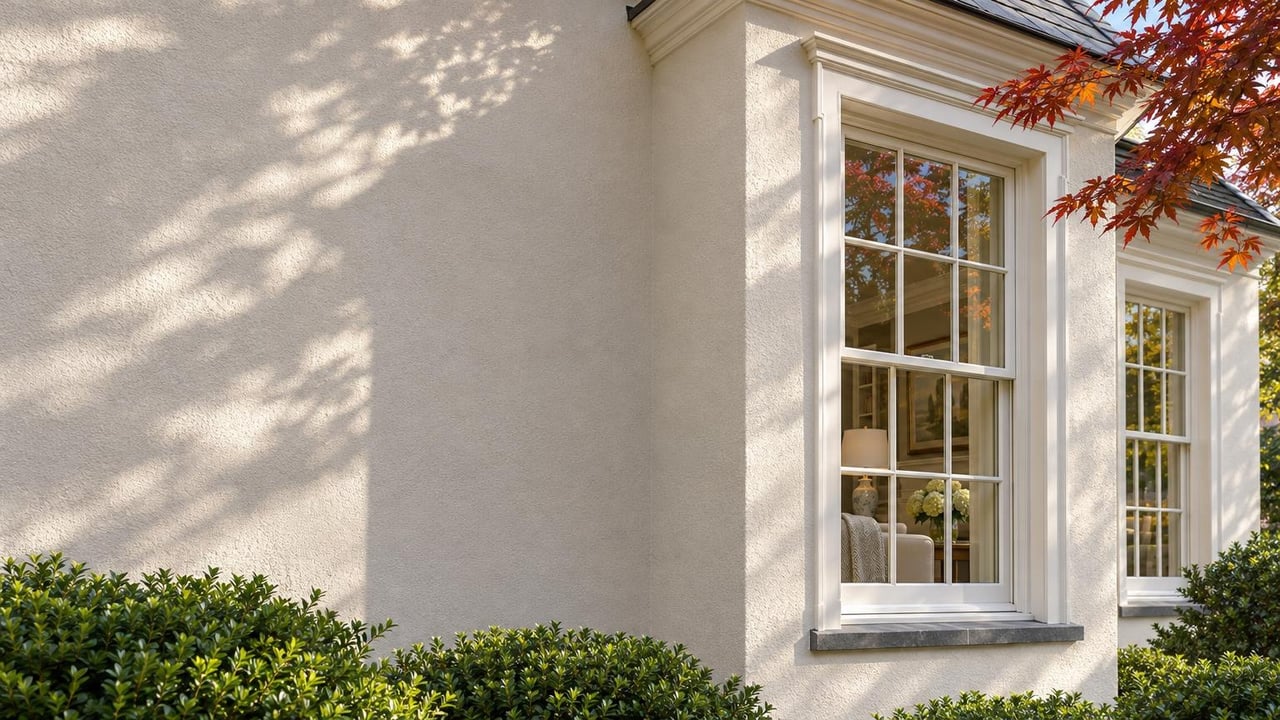
Synthetic stucco is the common name for EIFS, an exterior insulation and finish system. In a FOX 5 Atlanta report, it is described as an insulation board fastened to the exterior sheathing, covered with a base coat reinforced with fiberglass mesh and topped with a finish coat that looks like stucco. The same report says the system became popular on higher-end homes and was used on almost 30% of homes built in the Southeast by the early 1990s. That period overlaps Windward's busiest building years. The report also relays a local real estate expert's view that buyer stigma still follows EIFS homes.
The stigma is the real pricing problem. A buyer who sees synthetic stucco and has no data tends to assume the worst and discount for it. A seller with a clean probe report can replace that assumption with measured readings from the house's own walls.
Where the Probes Go In
A stucco inspection starts with a walk around the house, before anyone drills a hole. Stucco Siding Inspection Solutions, a metro Atlanta firm, describes a first visual phase. The inspector looks for cracks, stains, head flashing over windows, kick-out flashing where a roof edge meets a wall, and signs of leaks inside the house.
When the visual phase calls for it, invasive testing follows. The same firm drills two pencil-diameter holes about an inch apart and pushes a digital probe meter through the coating to measure moisture in the material behind it. It concentrates on the lower corners of windows and penetrations and on the joints where a roof meets a wall, then seals the holes. The firm says infrared scanners can help find wet areas but do not replace probing. It also says destructive openings may be needed to see flashing or damage that the probes can't reach.
On a typical two-story Windward house, the probe locations follow the house's details. Atlanta Stucco Homes lists windows, flashing, roof-to-stucco transitions, deck connections, terminations and penetrations among its inspection points. A house with a deck has a joint where the deck framing ties into the wall. A house with a hose bib, a dryer vent and a bay window has more openings through the coating. Each of those openings is another place to probe.
Lakefront lots have their own items on the list. The Foresight Windward page says homes on Lake Windward need a specialized look at elevated deck ledger boards, joist hangers and shoreline retaining structures. On a lakefront house with synthetic stucco, the deck ledger and the wall it attaches to are a single connection, and they should be inspected together.
What the Inspection Costs, and What the Answers Cost
An inspection costs little compared with what it tells you. Atlanta Stucco Homes currently lists its EIFS inspections at $400 for homes under 3,000 square feet, $500 under 5,000 and $600 under 7,000. It notes that the final price depends on the house's size and access. The firm recommends including the inspection report with the closing documents.
The fix depends on how much of the wall is wet and where. An Alpharetta envelope contractor, ASR, describes localized repair: remove the wet EIFS and damaged sheathing, correct the flashing, rebuild the wall and replace failed sealant. Sound areas may only need a recoat. Where barrier EIFS is wet across large areas, the options listed are converting to drainable EIFS, hard-coat stucco or fiber cement. ASR's page is written for commercial buildings, but residential walls face the same choice between repair and conversion.
For full remediation, the Foresight page gives a benchmark of $15,000 to $60,000 or more for remediation or hard-coat recladding. That figure is an inspector's estimate, not a contractor's bid. It is still useful for showing scale. An inspection in the $400 to $600 range can tell a seller whether a house faces a sealant-and-flashing repair or work toward the top of that range. Without one, a buyer has no way to tell the two apart, and buyers usually discount for the worst case.
Every figure here comes from a firm's own published pricing or estimate. This post is general information, not legal, financial or tax advice, so confirm the numbers for your own house with the inspector and contractors you hire.
What a Windward Purchase Carries Besides the House
The walls are one part of what a Windward buyer pays for. Windward's homeowners association says on its buyer information page that buyers pay a one-time capital contribution at closing. The swim, tennis and marina club and the golf club are separate, privately owned memberships that cost extra.
According to the AJGA, the Golf Club of Georgia's Lakeside course was designed by Arthur Hills, opened in 1991 and plays along Lake Windward on its back nine. The lake club now operates as Racket Social Club at Windward Lake and was acquired by Racquet 360 in 2025. Those amenities date to the same years as the houses, and both still factor into what buyers pay.
Reading a Windward Listing With This in Mind
The year built on a listing gives you a starting point. A house from 1985 to 1996 raises both questions, the supply pipe and the cladding. A late-1990s executive home with synthetic stucco raises the cladding question first. In a house that someone has already re-plumbed or re-clad, the work turns into documentation: who did it, when and what the moisture readings were.
Some Windward houses have a stucco elevation on the front and siding on the sides and back. Others are clad in stucco on all four sides. That affects how many walls need probing and which inspection tier the house falls into. Spinnakers, a 55-home New England-style village on a Lake Windward peninsula, has a different look from the larger 1990s executive streets, which shows that the community's 44 neighborhoods weren't built to one specification. Evaluate each Windward house on its own walls rather than on the community's general reputation.
Sellers have the most control over timing. A probe test before listing puts the result in the seller's hands while there is still time to make repairs and gather paperwork. A buyer's test after a contract is signed puts the same information into a negotiation with a deadline. For more on how Alpharetta's market is pricing homes right now, and how I evaluate a house from a builder's perspective, see The Builder's Eye. The same approach to evaluating build quality applies on the Milton side of Windward Parkway.
If you own a Windward home built in the 1980s or 1990s and want to know where its walls and pipes put its value before you decide on timing, start with a free home valuation. I'll go through the house the way I learned to in the lumber yard, from the flashing in, and give you clear options. Wesley Harper